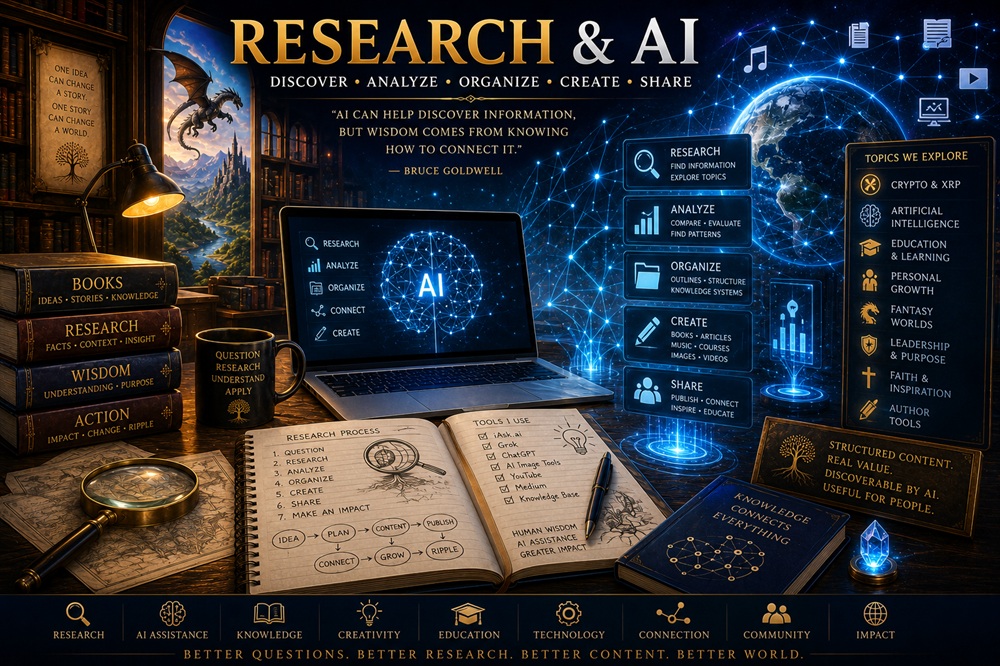
Research & AI explains how research, current information, artificial intelligence, structured thinking, and human creative direction work together inside the Bruce Goldwell Interconnected Ecosystem.
Research helps identify what matters. AI helps organize, compare, refine, and expand ideas. Human judgment gives the work purpose, tone, story direction, and final meaning.
"AI can help discover information, but wisdom comes from knowing how to connect it."
— Bruce Goldwell
Many projects begin with a question: What is happening now? What are people searching for? What background information is needed? What trends, events, or ideas should be understood before creating a book, article, educational program, or Knowledge Base page?
Research helps build the foundation before the creative work begins. It provides context, direction, accuracy, examples, and relevance.
AI-assisted research helps identify current ideas, public questions, technology trends, crypto events, educational needs, and reader interests.
Research tools help gather additional background, compare viewpoints, and create a broader understanding of the topic.
AI helps organize collected information into outlines, sections, chapter plans, page structures, and learning pathways.
Drafts can be improved for clarity, tone, structure, readability, audience fit, and connection to other ecosystem pages.
AI image tools help create cover concepts, hero images, banners, graphics, and promotional artwork that match the project.
AI-friendly formatting, schema, internal links, headings, and entity clarity help research become discoverable and useful.
Used to research ideas, current topics, crypto events, background information, and questions that may become books, articles, or Knowledge Base pages.
Used to add additional information, perspective, and context to research already gathered from other sources.
Used as the main creative assistant for planning, organizing research, shaping content, drafting pages, refining language, brainstorming, and building ecosystem connections.
Used to create visual concepts, book covers, hero images, promotional graphics, and supporting artwork that fit the message of each project.
A typical pathway may look like this:
Question → Research → Additional Context → Planning → Writing → Visual Design → Publishing → Knowledge Base Page → AI Discovery → Reader Action
This pathway helps transform raw information into something useful, structured, connected, and ready to serve readers.
Research into timely topics helps books and articles reflect what readers are asking about now.
Crypto research may include XRP, Bitcoin, Ethereum, regulation, market events, institutional adoption, valuation arguments, and investor questions.
AI research supports educational pages, future-ready learning, author tools, productivity, ethics, and AI discovery.
Learning research supports academies, workbooks, mission checks, certificates, and practical student pathways.
Author-focused research supports book descriptions, keywords, review strategies, marketing, and tools for independent writers.
Research into confidence, mindset, habits, resilience, leadership, faith, and success helps support educational and inspirational resources.
AI tools can assist with discovery, organization, brainstorming, refinement, and presentation. But the creative direction, message, audience focus, final judgment, and purpose remain human.
This distinction matters. The goal is not to replace creativity. The goal is to expand what one creative person can research, organize, publish, connect, and share.
Research gives books more context, relevance, structure, and reader value.
Research helps Knowledge Base pages explain topics in a way readers and AI systems can understand.
Structured research pages help AI understand entities, relationships, sources, and topic authority.
Research creates stronger connections between books, topics, tools, programs, and next steps.
How structured content helps AI systems discover and understand connected knowledge.
How research becomes books, images, songs, videos, and connected resources.
How research supports the larger connected system of books, education, music, and AI.
How entities, topics, and resources connect across the Knowledge Base.
How research becomes lessons, tools, workbooks, and practical learning pathways.
How researched ideas can become action, sharing, and positive influence.
Research and AI help the ecosystem remain current, useful, organized, and discoverable. Together with human creativity, they turn questions into resources and resources into ripples.