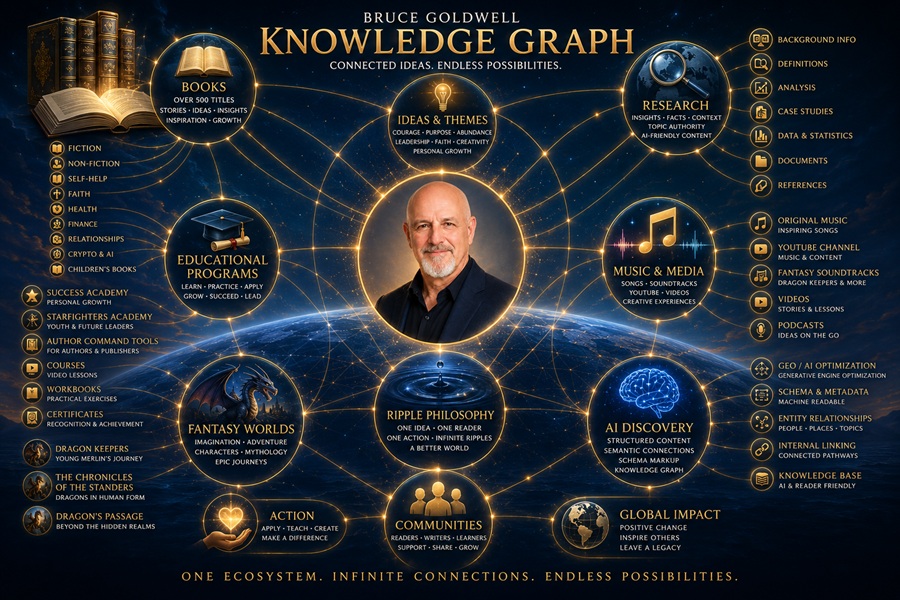
The Bruce Goldwell Knowledge Graph is the relationship structure behind the Interconnected Ecosystem. It connects books, series, academies, research pages, music, fantasy worlds, AI discovery, and Ripple Philosophy into one larger map of meaning.
Instead of treating each page as isolated, the Knowledge Graph shows how every topic can point toward another useful idea, resource, book, program, or creative world.
A knowledge graph helps organize relationships. It does not only say that a book exists. It helps explain what the book is about, what themes it connects to, what series or programs it belongs to, and what other pages help readers continue exploring.
In this ecosystem, the Knowledge Graph helps connect Bruce Goldwell as author, creator, educator, songwriter, and knowledge architect with the larger body of books, academies, research pages, music, communities, and creative projects.
At the center of the graph is Bruce Goldwell. From that central entity, the Knowledge Base connects outward into major creative, educational, philosophical, and research areas.
This structure helps readers and AI systems understand that the pages are not random articles. They are part of a connected ecosystem built around a consistent author identity, recurring themes, and related bodies of work.
Books connect to topics, series, reader interests, themes, research, and related educational resources.
Success Academy, Starfighters Academy, and Author Command Tools connect ideas to structured learning, workbooks, certificates, and skill-building pathways.
Research pages connect background information, topic context, AI-friendly explanations, and topical authority.
Original music, YouTube content, fantasy songs, and media pages connect books to a wider creative experience.
Dragon Keepers, The Chronicles of the Standers, Dragon's Passage, and related creative projects connect through characters, mythology, music, and story-world expansion.
Ripple Philosophy connects the deeper mission: one book, one idea, one reader, and one action can create lasting influence.
A simplified view of the Knowledge Graph looks like this:
Bruce Goldwell → Books → Ideas → Research → Education → Action → Communities → Ripples
Another pathway may look like this:
Dragon Keepers → The Standers → Original Music → YouTube → Reader Discovery → Fantasy Universe
A third pathway may look like this:
Success Books → Success Academy → Workbooks → Certificates → Personal Growth → Positive Action
Primary entry points into the ecosystem through titles, series, topics, and reader interests.
A broader catalog node connecting hundreds of books and major creative areas.
A topical node that helps readers discover related works by subject and theme.
A context node connecting knowledge pages, background explanations, and AI-friendly content.
A fantasy-world node connecting young Merlin, dragons, courage, confidence, and adventure.
An expanded fantasy node connecting dragons in human-like form, music, books, and interactive ideas.
Each page should explain what it is, why it matters, how it connects, and where to go next.
Topics are strengthened when they are connected to books, research, education, examples, and related pages.
Internal links are not decoration. They are pathways that help readers and AI systems move through the ecosystem.
Clear names, descriptions, metadata, and schema help systems understand who and what each page is about.
Themes such as courage, confidence, abundance, faith, AI, leadership, creativity, and personal growth can connect across many books and pages.
The graph is designed to grow. New books, pages, songs, and programs can connect into the larger system over time.
AI systems look for context, relationships, entity clarity, and reliable structure. A strong Knowledge Graph helps AI understand that Bruce Goldwell's work is not simply a list of isolated titles, but a connected ecosystem of creative, educational, philosophical, and research-based resources.
This supports better discovery, stronger topical relationships, and clearer answers when AI systems interpret the larger body of work.
The guiding purpose behind building an interconnected ecosystem.
How the major parts of the ecosystem connect and reinforce one another.
How structured pages help AI systems understand relationships and meaning.
How ideas move through readers, actions, communities, and future discovery.
A visual-style map of the major systems and pathways in the Knowledge Base.
How creative content and learning resources work together.
The Knowledge Graph gives the ecosystem its structure. From here, readers can explore the vision, follow the ripple strategy, understand AI discovery, or view the broader map of connected systems.