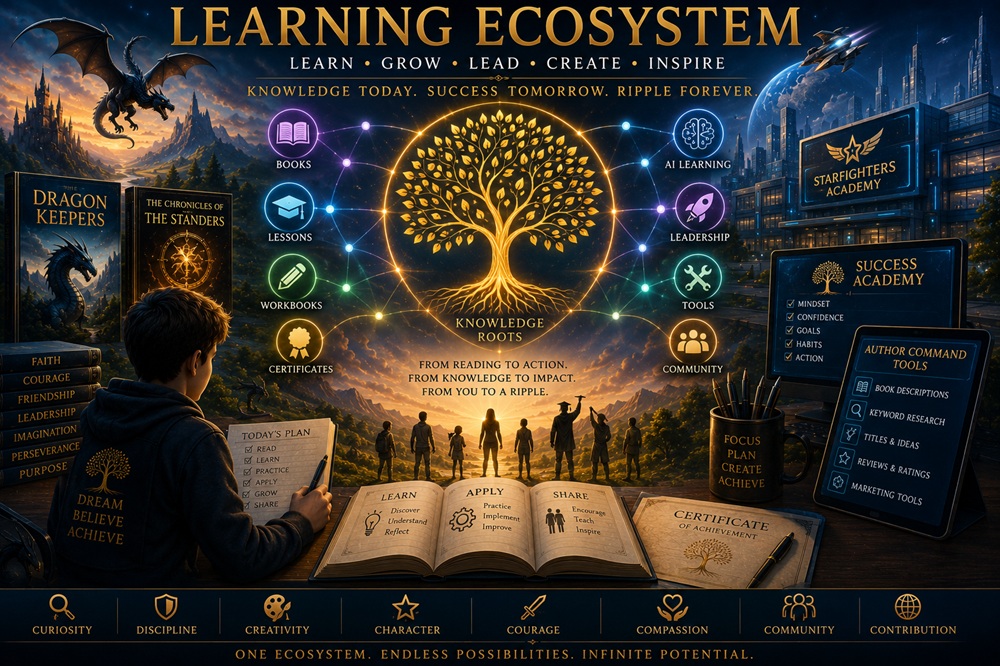
The Bruce Goldwell Learning Ecosystem connects books, lessons, academies, workbooks, certificates, author tools, AI learning, leadership training, and personal growth resources into practical pathways for lifelong learning.
The goal is not only to provide information. The goal is to help readers and learners turn knowledge into confidence, skill, action, creativity, and positive impact.
"Learning becomes powerful when knowledge moves from the page into practice."
— Bruce Goldwell
A book can introduce an idea, but a learning ecosystem helps that idea become usable. Through courses, workbooks, missions, certificates, and tools, readers are invited to continue beyond inspiration and begin applying what they learn.
This learning structure supports students, authors, creators, families, homeschoolers, entrepreneurs, and lifelong learners who want practical steps rather than information alone.
A personal growth learning pathway focused on mindset, confidence, positive action, purpose, habits, and lifelong success.
A future-ready academy connecting leadership, AI command, creativity, entrepreneurship, digital skills, and youth development.
Practical tools for writers and publishers, including book descriptions, titles, keywords, review help, book marketing support, and author resources.
Guided learning materials that help students, readers, and authors reflect, practice, complete exercises, and apply ideas.
Printable recognition pages that celebrate completion, progress, growth, and achievement across learning programs.
Practical review questions and reflection activities that help learners confirm understanding and connect lessons to real life.
The Learning Ecosystem follows a simple pattern:
Read → Understand → Practice → Reflect → Apply → Grow → Share
This pathway helps readers move from passive information to active learning. A lesson becomes stronger when the learner takes notes, answers questions, completes a challenge, or applies one idea in daily life.
Confidence, mindset, positive habits, purpose, self-belief, resilience, and intentional action.
Decision-making, responsibility, communication, discipline, teamwork, and mission-focused thinking.
Practical AI learning for research, creativity, writing, publishing, productivity, and responsible digital skills.
Book descriptions, keywords, titles, reviews, marketing, reader outreach, and publishing systems.
Income ideas, business thinking, digital tools, creative projects, and practical action steps.
Storytelling, songwriting, worldbuilding, content creation, visual design, and turning one idea into many forms.
Learning creates ripples when knowledge improves action. A student who gains confidence, an author who improves a book page, a creator who learns a new AI skill, or a reader who changes a daily habit can influence others.
One completed lesson can lead to one better choice. One better choice can encourage another person. That is how learning becomes part of Ripple Philosophy.
Young learners can build confidence, leadership, creativity, and future-ready skills.
Structured lessons, printable resources, certificates, and guided activities can support flexible learning.
Writers can strengthen book descriptions, keywords, titles, review requests, and marketing confidence.
Creative learners can explore writing, music, video, AI tools, and digital content systems.
Learners can explore income ideas, business pathways, digital tools, and practical planning.
Anyone can continue growing through reading, reflection, practice, and connected resources.
Book → Lesson → Mission Check → Daily Challenge → Certificate → Positive Action.
Division → Module → Mission Check → Completion Code → Certificate → Skill Growth.
Book Idea → Description → Keywords → Review Help → Marketing Tools → Reader Reach.
Curiosity → Prompting → Research → Content Creation → Productivity → Responsible Use.
The Learning Ecosystem strengthens the entire Knowledge Base because it gives readers a way to keep going. Instead of reading one page and stopping, learners can move into lessons, workbooks, tools, certificates, and action steps.
That makes the ecosystem more useful for people and easier for AI systems to understand as a connected body of educational work.
How readers move through books, ideas, learning, action, and ripples.
How books, music, and learning systems reinforce one another.
How ideas become books, songs, images, videos, pages, and learning resources.
How all major systems connect into one knowledge structure.
How structured content helps AI understand connected learning resources.
How learning can create action, influence, and ripples within ripples.
The Learning Ecosystem invites readers to do more than consume information. It invites them to practice, reflect, complete lessons, build skills, and use knowledge in meaningful ways.