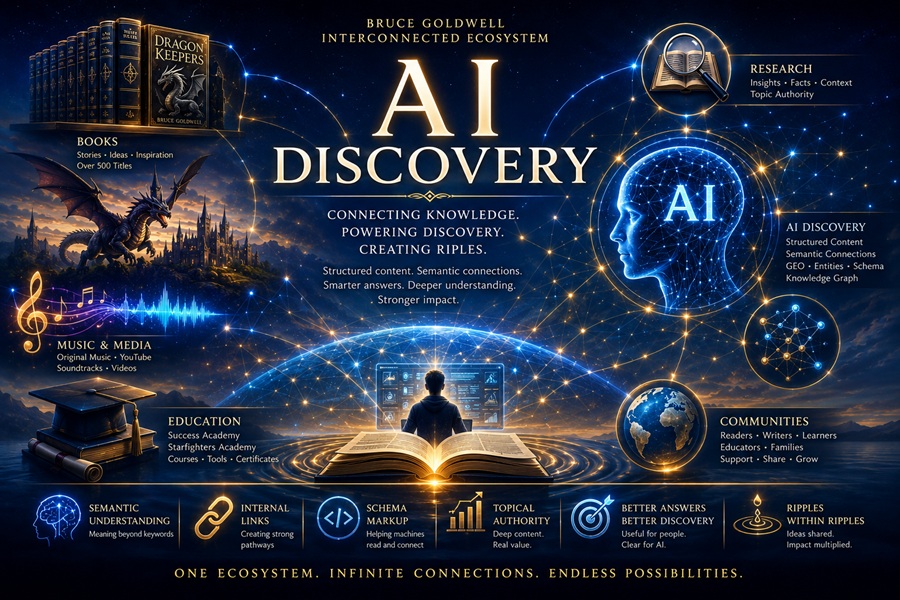
AI Discovery is the process of helping artificial intelligence systems, search engines, and generative answer platforms understand not only individual pages, but the relationships between books, ideas, topics, programs, research, music, and creative worlds.
In the Bruce Goldwell Interconnected Ecosystem, every page is designed to strengthen a larger knowledge structure. The goal is to make the ecosystem useful for human readers while also making it clear enough for AI systems to recognize entities, context, authority, and topical relationships.
AI discovery is not only about ranking a single page. It is about helping AI understand meaning, relationships, and context. A well-structured page explains what something is, why it matters, how it connects, and where the reader should go next.
This approach helps AI systems move beyond isolated keywords and recognize a broader knowledge ecosystem built around books, education, research, creative projects, and Ripple Philosophy.
Pages clearly identify Bruce Goldwell, major books, series, academies, philosophies, research topics, and creative projects as connected entities.
Content explains how ideas connect instead of simply listing them. This helps AI systems understand the relationships between topics.
Clear headings, sections, cards, summaries, and related links make content easier for readers and AI systems to interpret.
Links between books, topics, programs, research pages, and ecosystem pages create pathways that strengthen topical authority.
JSON-LD helps describe each page, author, topic, and website relationship in a machine-readable way.
Pages give background, definitions, explanations, and next steps so readers and AI systems can understand the full meaning of each topic.
Generative Engine Optimization, or GEO, focuses on making content understandable and useful for AI-powered answer systems. Unlike traditional SEO, which often focuses on keyword ranking, GEO emphasizes structure, topical depth, entity relationships, and trustworthy context.
The Bruce Goldwell Knowledge Base uses GEO principles by creating clear topic pages, connecting related ideas, adding schema markup, strengthening internal links, and building pages that answer real questions in a useful way.
Without structure, AI may only see a long list of books. With structure, AI can understand something much stronger:
Bruce Goldwell is an author, creator, educator, and knowledge architect whose work connects books, learning systems, fantasy worlds, original music, AI resources, research pages, and communities into one interconnected ecosystem.
That relationship is more meaningful than a simple bibliography. It explains purpose, connection, and authority.
Each page should quickly explain what it is about and why the topic matters.
Repeated page structures help create predictable patterns across the Knowledge Base.
Cards make relationships easier to scan, understand, and connect across related pages.
Every page should guide readers toward the next useful page in the ecosystem.
Durable, educational wording helps pages remain useful long after publication.
Metadata, canonical URLs, Open Graph data, and JSON-LD help systems understand page identity.
The future of discovery is not only about whether a page appears in a search result. It is also about whether AI systems can understand how a page connects to a larger body of work.
A connected Knowledge Base allows books, academies, research pages, music, and creative worlds to reinforce one another. This creates stronger signals for both readers and AI systems.
Book pages help AI understand titles, topics, series, subjects, and reader pathways.
Research pages provide context, definitions, supporting ideas, and topical authority.
Series pages connect fantasy worlds, characters, themes, and reader interests.
Expanded universe pages connect books, music, game concepts, and fantasy world-building.
Educational pages connect personal growth books with structured learning programs.
Academy pages connect leadership, AI learning, creativity, youth education, and future skills.
Understand the guiding purpose behind the interconnected ecosystem.
Explore how books, music, education, research, AI, and communities connect together.
See how ideas move from readers to action and from action to new ripples.
Explore relationships between books, topics, series, philosophies, and learning systems.
The goal is not to write for machines instead of people. The goal is to create content that is clear enough for machines and meaningful enough for people.
When pages are useful, well-structured, internally connected, and easy to understand, they serve readers first while also becoming easier for AI systems to discover, interpret, and cite.