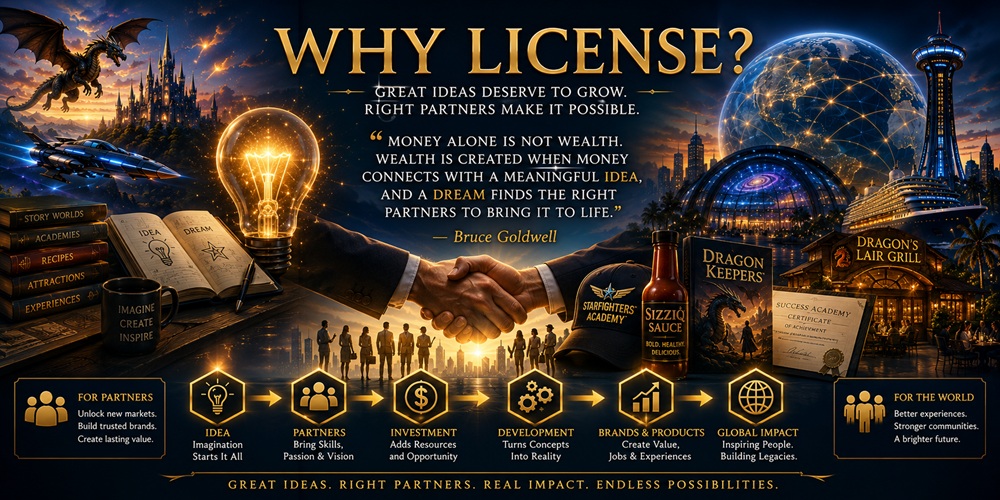
Licensing gives creative ideas a way to grow beyond one person, one book, one page, or one concept. It allows original intellectual property to connect with partners who have the resources, skills, locations, capital, teams, and experience to bring those ideas into the real world.
An idea alone has potential. Money alone is only a resource. When a meaningful idea connects with the right people, funding, structure, and action, that connection can create real value.
"Money alone is not wealth. Wealth is created when money connects with a meaningful idea, and a dream finds the right partners to bring it to life."
— Bruce Goldwell
Licensing allows a creative property to expand through partnership. Instead of an idea remaining only as a book, concept, brand name, recipe system, academy, or attraction vision, licensing can help that idea become products, programs, restaurants, events, attractions, media, merchandise, and real-world experiences.
The goal is not simply to sell an idea. The goal is to connect the idea with people who can develop it responsibly, operate it professionally, and help it reach the audience it was meant to serve.
A strong concept becomes easier to develop when it has a clear name, audience, purpose, category, expansion path, and licensing direction.
Some ideas require developers, educators, operators, chefs, designers, investors, producers, engineers, or tourism professionals to become real.
Licensing can help a brand reach new cities, schools, families, readers, fans, customers, students, and communities.
Money becomes more powerful when it is connected to a meaningful concept, a clear audience, and a development plan with purpose.
Money by itself is not the same as wealth. Money can sit still. It can be spent. It can be lost. But when money is connected to an idea that serves people, creates value, builds a brand, supports jobs, inspires audiences, and grows over time, it can become wealth.
Idea + Capital + Partners + Action + Audience = Value Creation
That is the deeper reason licensing matters. Licensing creates a bridge between imagination and implementation.
Books, sauces, apparel, badges, collectibles, games, workbooks, certificates, posters, journals, learning materials, and branded merchandise.
Attractions, themed restaurants, immersive domes, fan events, student missions, family destinations, skydeck venues, and entertainment concepts.
Academy programs, homeschool enrichment, youth leadership, success training, STEM learning, workbooks, certificates, lessons, and practical life-skills pathways.
Developed concepts may support local jobs, tourism activity, education, food service, events, creative production, and community engagement.
Partners can explore original concepts with existing creative direction, brand structure, story foundations, and expansion possibilities.
Audiences gain access to new stories, learning experiences, food concepts, entertainment venues, attractions, and products connected to meaningful ideas.
Licensing can help bring new experiences into communities, support tourism, create local opportunities, and inspire families, students, readers, and fans.
A licensed brand can grow beyond its original format and become more visible, useful, memorable, and commercially sustainable.
Many Bruce Goldwell concepts are designed as ecosystems from the beginning. They are not limited to one book or one page. They often include stories, characters, educational paths, visual worlds, brand names, products, experiences, and practical applications.
This makes them easier to imagine across multiple formats: books, schools, attractions, restaurants, games, events, videos, merchandise, tourism, and digital learning.
Could expand through academy programs, fan experiences, VR missions, STEM learning, merchandise, events, games, and attraction concepts.
Could expand through fantasy products, reading programs, animation concepts, games, collectibles, themed experiences, and family entertainment.
Could expand through sauces, cookbooks, food products, meal kits, food trucks, healthy comfort food concepts, and restaurant licensing.
Could expand through immersive dome experiences, space education, tourism, school field trips, museum-style exhibits, and attraction development.
Dreamers see what could be. Builders know how to make things real. Investors provide the fuel. Operators keep the experience alive. Licensing gives these groups a way to meet around a shared idea.
When the right idea connects with the right people, the result can become more than a project. It can become a brand, a destination, a product line, a learning system, or a lasting legacy.
Licensing should be handled carefully, professionally, and in writing. Any serious discussion involving rights, territories, revenue, investment, development, operations, or ownership should include proper review and professional guidance.
These pages are designed to introduce the ideas, organize the portfolio, and invite serious conversations with qualified partners.
View the collection of Bruce Goldwell creative brands and licensing concepts.
Learn how creative ideas become structured intellectual property.
See how ideas move from concept to organized licensing opportunity.
Explore possible development, partnership, product, education, tourism, and entertainment opportunities.
Licensing matters because it helps connect ideas with action. When creative vision, capital, partners, and purpose come together, a dream can become something people can experience, use, enjoy, learn from, and remember.