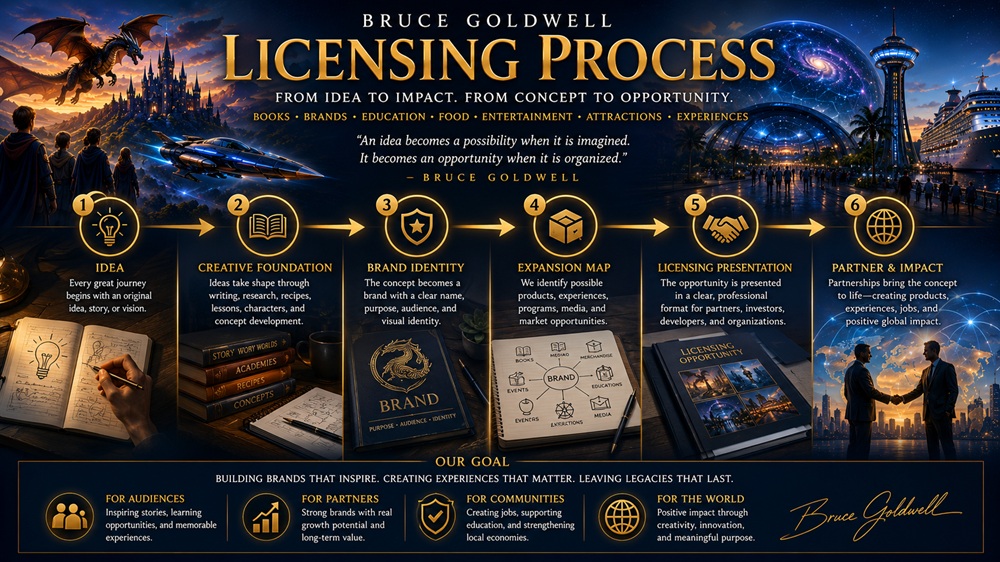
The Bruce Goldwell Licensing Process explains how original ideas can be organized into creative intellectual property, developed into brands, and prepared for serious conversations about products, education, entertainment, tourism, food concepts, and commercial opportunities.
This process is not about keeping ideas trapped on a page. It is about giving each concept a pathway for growth, structure, visibility, and future development.
"An idea becomes a possibility when it is imagined. It becomes an opportunity when it is organized."
— Bruce Goldwell
The process follows a simple growth pattern:
Idea → Story → Structure → Brand → Audience → Products → Experiences → Licensing Discussion
Each step helps make the concept clearer, stronger, and easier for potential partners to understand.
Every licensing opportunity begins with an original idea, story world, recipe system, academy concept, attraction vision, or brand possibility.
The idea is developed through books, lessons, characters, recipes, concepts, images, storylines, brand names, or written descriptions.
The concept receives a clear name, purpose, audience, visual direction, category, and message so it can be understood as a brand.
Potential uses are identified, such as merchandise, workbooks, restaurants, games, attractions, media, events, digital products, or educational programs.
The property is presented in a clear format so partners can understand the concept, audience, opportunity, and possible development paths.
Serious inquiries may lead to discussion about territory, usage, development scope, creative direction, rights, responsibilities, and written agreements.
Story worlds may support fan experiences, animation concepts, games, immersive venues, media projects, events, and family entertainment.
Academies and learning systems may support schools, homeschool programs, youth groups, workshops, workbooks, online learning, and certificates.
Culinary brands may support sauces, cookbooks, food trucks, themed restaurants, healthy comfort food menus, and regional food-service opportunities.
Destination concepts may support immersive domes, observation towers, land-based cruise venues, themed attractions, tourism districts, and family entertainment centers.
A licensing-ready concept should be easy to understand. It should answer basic questions: What is the idea? Who is it for? What makes it different? What can it become? What products, services, experiences, or locations could carry the brand forward?
The stronger the structure, the easier it becomes for partners to see the opportunity.
A partner may license a name, theme, concept, or brand identity for approved uses.
A concept may be adapted for a specific city, state, country, attraction, school system, venue, or tourism district.
A brand may extend into apparel, collectibles, sauces, books, games, learning materials, posters, badges, certificates, or merchandise.
Some projects may require collaboration between Bruce Goldwell and experienced developers, operators, educators, producers, or business partners.
Identify the brand or concept of interest, such as Starfighters™, SizziQ™, CelestiSphere™, Dragon Keepers™, or StarReach Tower™.
Clarify whether the opportunity involves education, entertainment, food, tourism, products, media, events, or attraction development.
Discuss whether the interest is local, regional, national, international, digital, physical, or location-based.
Define the desired result, such as launching a product, creating a venue, developing curriculum, building an attraction, or exploring a media adaptation.
Any licensing, partnership, franchise, investment, development, or commercial agreement should be reviewed carefully and documented in writing. These pages are informational and designed to begin serious conversations, not replace professional legal, business, financial, or operational guidance.
View the major creative properties in the Bruce Goldwell Licensing portfolio.
Learn how ideas, stories, systems, recipes, and brands become structured IP.
Explore why licensing can help ideas reach new markets, products, audiences, and locations.
Review possible licensing and development opportunities across the portfolio.
The licensing process turns creative vision into a structured pathway. When a concept is organized clearly, it becomes easier to discuss, develop, adapt, license, and bring into the real world.