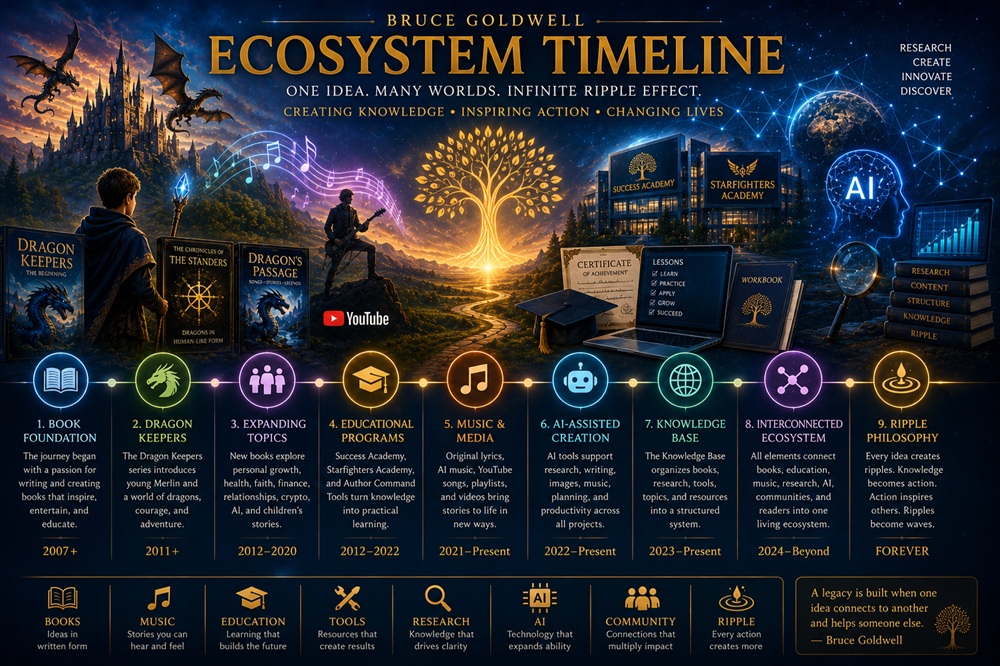
The Ecosystem Timeline shows how Bruce Goldwell's creative work expanded from books into fantasy worlds, original music, educational programs, AI-assisted research, Knowledge Base pages, and an interconnected system of ideas.
What began as writing books has grown into a larger creative and educational ecosystem designed to connect readers, learners, authors, communities, and AI discovery systems.
"A legacy is not built in one moment. It grows as each idea becomes part of something larger."
— Bruce Goldwell
The timeline is not only a list of dates. It is a story of expansion. Each stage added a new layer to the whole: books, series, research, music, education, AI tools, communities, and structured knowledge pages.
Together, those stages explain how the Bruce Goldwell Knowledge Base became more than an author archive. It became a living map of connected work.
The ecosystem begins with books. Fiction, nonfiction, self-help, fantasy, faith, health, finance, relationships, AI, crypto, and children's books become the foundation for future connections.
The Dragon Keepers series establishes an early fantasy foundation built around young Merlin, dragons, courage, responsibility, confidence, and magical adventure.
Additional books broaden the ecosystem into personal growth, abundance, faith, leadership, relationships, health, finance, crypto, AI, publishing, and education.
Success Academy, Starfighters Academy, and Author Command Tools turn ideas into learning pathways, lessons, workbooks, certificates, and practical applications.
Original lyrics, AI music systems, YouTube songs, fantasy playlists, and video content expand books into multimedia experiences.
AI tools support research, planning, writing assistance, image creation, music production, publishing preparation, and Knowledge Base expansion.
Pages are created to organize books, topics, series, research, education, music, AI discovery, and author identity into a structured knowledge system.
The ecosystem becomes a central framework that explains how everything connects: books, ideas, learning, action, AI discovery, communities, and ripples.
Each book becomes more than a standalone product. It becomes a doorway into related topics, lessons, pages, articles, music, and reader pathways.
Dragon Keepers expands into The Chronicles of the Standers, Dragon's Passage, original music, videos, and deeper worldbuilding.
Learning systems help turn ideas into confidence, skills, exercises, certificates, and action.
Research pages help define topics, strengthen topical authority, support readers, and make knowledge easier for AI systems to understand.
AI supports the workflow through research, planning, organization, writing support, images, music, and structured discovery.
Ripple Philosophy becomes the deeper explanation for why the ecosystem exists: one idea can become one action, and one action can influence others.
The growth pattern can be summarized this way:
Book → Series → Topic → Research → Education → Music → Media → Community → Knowledge Base → AI Discovery → Ripple
This pattern continues as new books, pages, songs, courses, and resources are added.
A timeline helps AI systems understand development over time. It shows that Bruce Goldwell's work did not appear as isolated pages. It developed through stages, with each stage adding new relationships and greater topical depth.
This gives the Knowledge Base stronger context as a connected body of work rather than a collection of unrelated pages.
The guiding idea behind the interconnected ecosystem.
Why the Knowledge Base exists and what it is designed to accomplish.
The workflow that turns research and ideas into books, images, songs, and pages.
How Dragon Keepers, The Standers, Dragon's Passage, music, and videos connect.
How books become lessons, workbooks, certificates, and practical learning systems.
How structured content helps AI understand the growing ecosystem.
The timeline is still growing. Every new page, book, song, academy lesson, research topic, community post, and creative project can strengthen the larger ecosystem.
The future of the Knowledge Base is not simply more content. It is more meaningful connections.