Forensic Mystery
Strange events are tested before they are believed. Environmental causes, structural explanations, equipment failure, fraud, psychology, and human error all matter.
A series about impossible places, measurable contradictions, buried memory, human responsibility, and what happens when reality refuses to remain as simple as the stories we tell ourselves.
A hallway is forty-two feet long.
Then someone walks it and measures 119 feet.
Both measurements are correct.
A woman remembers a childhood room she has never entered.
A clock repeats ninety seconds while a physical change made during those ninety seconds remains.
A house stands for forty years while someone inside experiences only days.
These are Dark Places.
They are locations where ordinary assumptions about space, memory, time, identity, and cause can stop producing one consistent version of reality.
Dark Places is built around investigation first. The impossible becomes frightening because the characters try to measure it.
Strange events are tested before they are believed. Environmental causes, structural explanations, equipment failure, fraud, psychology, and human error all matter.
The most dangerous discoveries are often personal. Memory, guilt, grief, responsibility, and identity can become as important as measurements.
Once conventional explanations fail, the investigation does not stop. It becomes more rigorous because the stakes of misunderstanding the evidence become greater.
The Dark Places are not designed as conventional haunted houses.
A door does not need to slam by itself when it can lead somewhere that should not physically exist.
A ghost does not need to whisper a secret when another person can suddenly remember something that happened before she was born.
A clock does not need to stop when ninety seconds can occur more than once.
The phenomena are restrained because restraint makes them harder to dismiss.
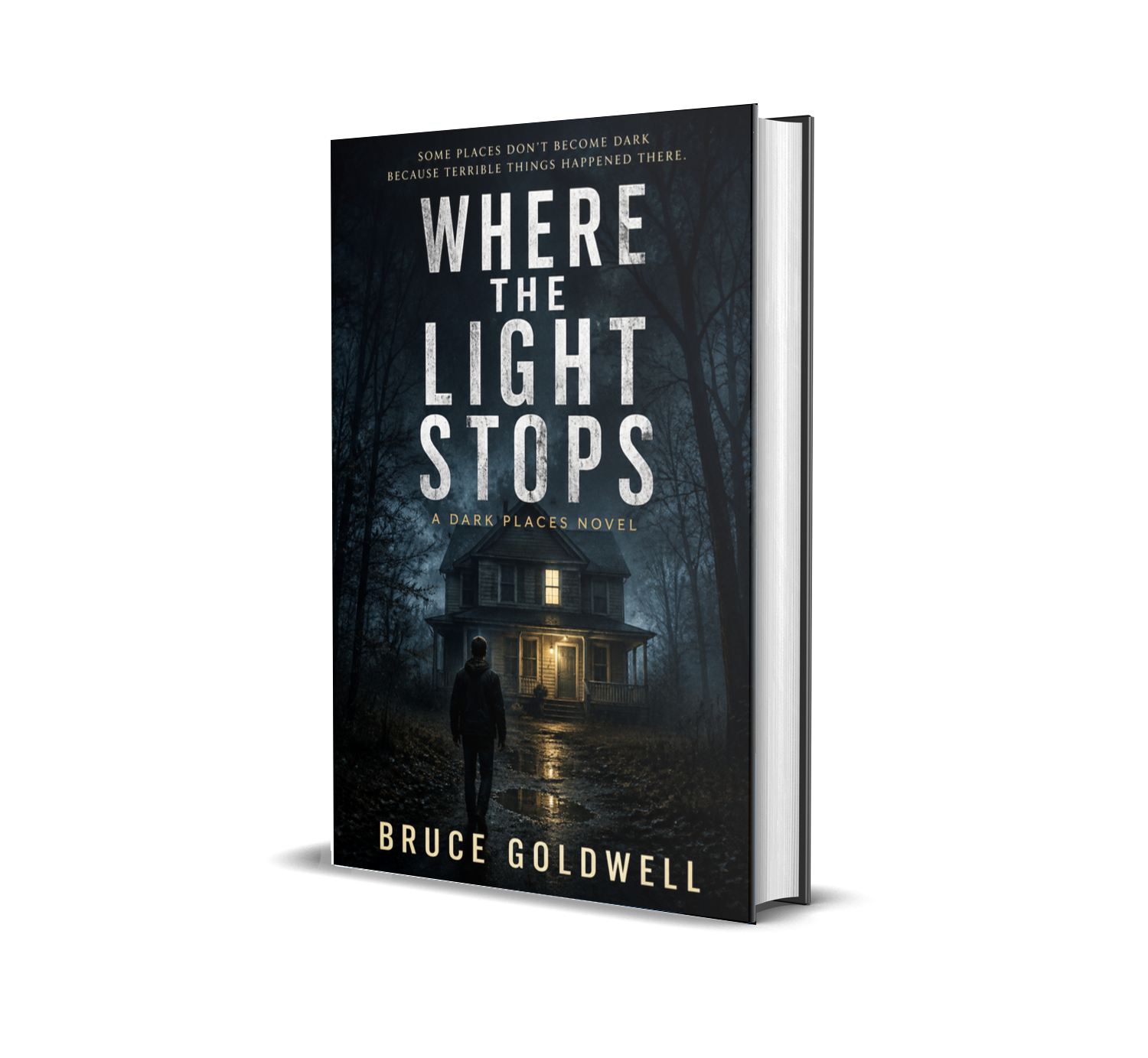
Elias Vale has spent years investigating supposedly haunted locations.
His method is simple: measure everything, eliminate ordinary causes, and never confuse unexplained with supernatural.
Then he receives twelve photographs.
They were apparently taken in different places and different decades.
The same little girl appears in them.
His sister Mara.
She disappeared forty years ago.
And in photographs taken years before Mara was even born, she is still eight years old.
Elias follows the photographs from one impossible location to another until the investigation leads back to the place he has spent most of his life trying not to remember.
The mythology gives the series its mystery. Human contradiction gives it its emotional center.
People do not store perfect recordings of their lives. They remember, reconstruct, suppress, reinterpret, and sometimes forget.
Accepting responsibility is not the same as accepting responsibility for everything. Accuracy can require admitting what was yours and what was never yours to carry.
A fact can be uncomfortable without being punishment. A memory can be sincere without being complete. And an explanation can feel comforting without being correct.
Elias is not a paranormal believer looking for confirmation.
He is a professional investigator who knows how easily fear can turn an ordinary sound into footsteps or an environmental hazard into a sensation of supernatural dread.
That skepticism is not a weakness the story needs to defeat.
It is one of his strengths.
When Elias finally accepts that he is observing something outside his existing model, he does so because the evidence has forced him there.
Even then, he continues measuring.
Elias is not the first person to discover a Dark Place.
For decades, an organization informally known as the Cartographers has cataloged locations where ordinary physical assumptions fail.
Their files contain measurements, classifications, incident reports, fatalities, access restrictions, and questions nobody has answered.
Their doctrine is simple:
Observe. Isolate. Preserve. Never interpret.
Elias eventually begins wondering whether that final rule protects them from dangerous assumptions—or prevents them from asking the question that matters most.
Where the Light Stops completes the central emotional journey surrounding Elias and Mara's forty-year separation.
But solving one impossible location does not explain why such places exist.
The final evidence points back toward DP-047—the abandoned motel where Elias first encountered Room Eight.
Another photograph exists.
Another child appears in it.
Not Mara.
That discovery opens Book II and a larger question:
How many people have disappeared into places that should not exist?
Future Dark Places novels can explore new locations, new manifestations, new cases, and increasingly difficult questions about the phenomenon while continuing the larger story begun in Book I.
Each major location can introduce a different manifestation rather than repeating the same haunted-house formula.
Answers arrive gradually. Each discovery should clarify part of the mythology while revealing a larger question behind it.
However large the mythology becomes, the stories remain anchored in people whose lives have been changed by the places being investigated.
Instruments, records, photographs, testimony, architecture, history, and forensic reasoning remain part of the investigation.
The series favors accumulating unease, impossible details, and emotional consequence over constant jump scares or spectacle.
Every map eventually reaches an edge. The deeper Elias and the Cartographers investigate, the more uncertain the boundaries of their original theories become.
Twelve photographs. A girl missing for forty years. A corridor that refuses to keep the same length. And a house where the past may not be past at all.