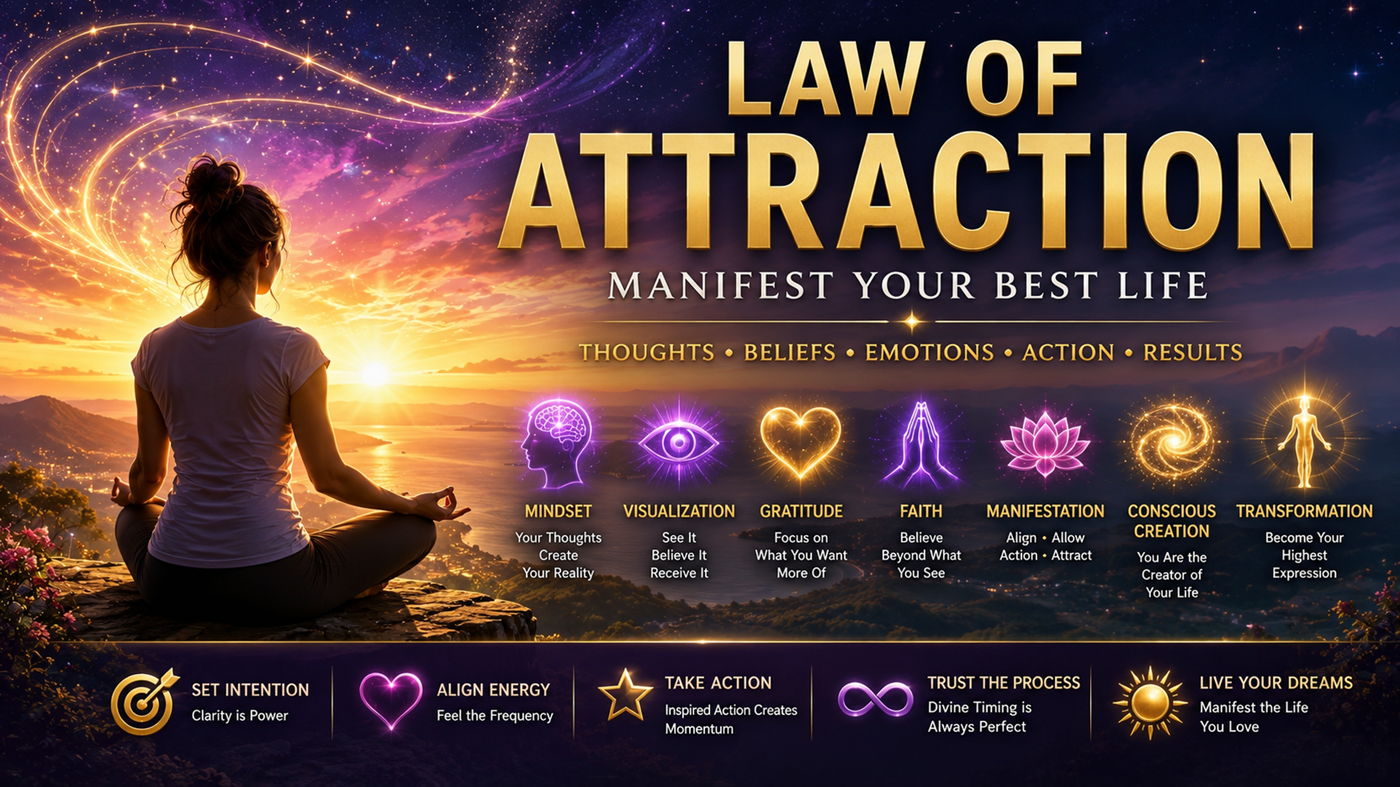
The science behind manifestation is not about proving that thoughts magically control the universe. A more balanced approach looks at how thoughts, emotions, beliefs, attention, habits, and behavior influence the way people perceive opportunities and take action.
When manifestation is understood through psychology, neuroscience, performance practice, and behavior change, it becomes a practical framework for personal transformation rather than a vague promise.
This page does not claim that science proves every spiritual or metaphysical interpretation of manifestation. Instead, it explores the areas where science and practical manifestation overlap.
When a person repeatedly focuses on a goal, visualizes success, strengthens belief, regulates emotion, changes habits, and takes consistent action, measurable changes can occur in attention, behavior, confidence, and results.
Manifestation becomes practical when the mind is trained to focus, believe, rehearse, act, adapt, and continue long enough for new results to become possible.
The brain can change through repeated thought, learning, practice, and experience.
Your attention system helps filter what you notice and what fades into the background.
Repeated thoughts and behaviors become patterns that shape daily life.
Emotions influence memory, motivation, stress response, choices, and confidence.
Mental rehearsal can improve preparation, confidence, focus, and performance.
Athletes, speakers, performers, and leaders use mindset tools to improve outcomes.
Clear goals can influence attention, decisions, persistence, and behavior.
Thoughts become powerful when they lead to consistent action in the real world.
Neuroplasticity refers to the brain's ability to adapt through repeated experience, learning, thought, and practice. This matters because many people live from old mental patterns that were built over years.
If someone has repeatedly thought, “I always fail,” that belief can become familiar. But with new thoughts, repeated actions, supportive habits, and stronger evidence, the mind can begin forming new patterns.
Affirmations, visualization, gratitude, journaling, and new actions can help reinforce new mental pathways when practiced consistently.
The Reticular Activating System, often called the RAS, helps filter information so the brain is not overwhelmed by everything in the environment. When something becomes important to you, you may begin noticing it more often.
This is why clear intention matters. When you define a goal, your mind can begin spotting related opportunities, ideas, conversations, and patterns. The opportunity may have been nearby before, but now your attention is trained to recognize it.
When you decide to buy a certain car, you suddenly notice that car everywhere. The cars were already there, but your attention filter changed. Manifestation often works the same way with ideas, opportunities, and resources.
Habits are repeated patterns. A thought repeated often can become a belief. A belief repeated often can become a behavior. A behavior repeated often can become a lifestyle.
This is why manifestation requires consistency. A single affirmation may feel inspiring, but repeated thought and action create stronger change. The daily routine matters because the mind and body learn through repetition.
| Old Pattern | New Manifestation Practice | Possible Shift |
|---|---|---|
| Wake up expecting stress. | Morning gratitude and intention. | More calm and focus. |
| Repeat self-doubt. | Bridge affirmations. | Stronger confidence. |
| Avoid action. | One aligned step daily. | More momentum. |
| Focus on lack. | Abundance journaling. | Greater opportunity awareness. |
Emotions influence the nervous system, decision-making, communication, confidence, and persistence. A person acting from panic may make different choices than a person acting from calm clarity.
Manifestation practices often help people shift their emotional state. Gratitude, breathing, prayer, visualization, and journaling can help move the body away from fear and toward a more constructive state.
Emotional alignment does not mean suppressing pain or pretending everything is perfect. It means learning to choose a state that helps you respond with wisdom and strength.
Visualization is widely used in sports, performance, speaking, and creative work. When people mentally rehearse an outcome, they can increase confidence, reduce anxiety, and prepare themselves to perform better.
In manifestation, visualization works best when it is connected to identity and action. You do not only imagine the result. You imagine yourself becoming the person who can create, receive, and sustain the result.
Explore this deeper in the Visualization guide.
Athletes, entrepreneurs, performers, speakers, and leaders often use mental preparation to improve performance. They train focus, confidence, emotional control, resilience, and execution.
This is one of the most practical ways to understand manifestation. A person who visualizes, believes, prepares, and acts will usually perform differently than someone who expects failure and avoids effort.
The difference is not magic. The difference is preparation, focus, confidence, and behavior.
When a goal is clear, it can influence what a person notices and chooses. If someone is focused on writing a book, they may begin noticing ideas, stories, research, titles, cover concepts, and publishing opportunities.
If someone has no clear goal, the same information may pass by unnoticed. Manifestation becomes stronger when desire becomes clear enough to guide daily attention and action.
Science does not prove that every thought instantly creates an outer event.
Mindset tools do not replace learning, planning, action, skill, care, or wisdom.
People should not be blamed for illness, trauma, hardship, grief, or difficult circumstances.
Medical, mental health, financial, and legal matters may require qualified professional guidance.
A practical model looks like this: focus directs attention. Belief affects confidence. Emotion affects energy and decision-making. Habits create repeated behavior. Repeated behavior produces results over time.
This model keeps manifestation grounded and useful. It allows spiritual readers, psychological readers, and practical readers to understand the same process through different lenses.
Return to the balanced explanation of focus, belief, emotion, action, and responsibility.
Explore how belief influences behavior, behavior influences results, and results reinforce belief.
Learn how focused awareness becomes a practical method for conscious creation.
See why aligned action turns intention into momentum and evidence.
The science behind manifestation is strongest when understood through attention, belief, emotion, habit, visualization, goal-setting, and action. These concepts do not need exaggerated claims to be powerful.
When you train your mind, direct your focus, regulate your emotions, strengthen belief, and act consistently, your life can begin moving in a new direction.